Showing posts with label history. Show all posts

A Day Out In History

The Black Country Museum from the Chapel steps

          I visited the Black Country Museum the other day.
          It’s an open air museum, dedicated to the industrial history of the Black Country, with many reconstructed buildings, illustrating what life was like in the area from the late 1700s to the 1930s.
          We chanced on a day  when many steam engines were chuntering around the site, and as we stepped from the entrance building, we breathed in coal-smoke, and ash I hadn’t smelled in many a long year.  It was the smell of my childhood. (Davy, a Scot and country boy, started coughing immediately, and said that he wouldn’t have lasted ten minutes in Ye Olde Blacke Countrie.  My family lasted, but it’s true that we have generations of bronchitis, severe coughs, sinus trouble and catarrh behind us.)
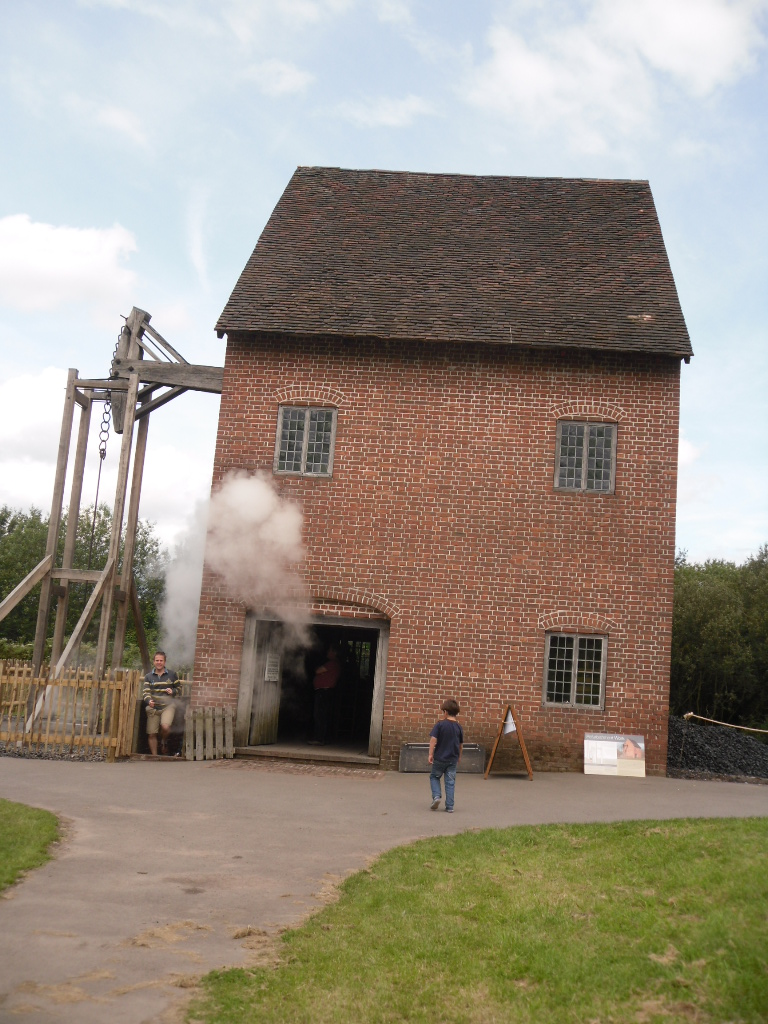
          We saw the ‘nodding donkey’ Newcomen engine steaming away.  It’s one of the oldest surviving engines, dating from 1712, and originally built to pump water from Lord Dudley’s mines, only a couple of miles from where it stands now.
          From there we visited the mine.  It’s a ‘fake’ mine, but within the constraints of not actually injuring or killing visitors, an effective one.  As you go round, tableau are illuminated, and a recorded voice – supposedly that of an old miner – tells you about the work done by the miners in the 19th century. 
          The low, narrow, dimly lit tunnels give a very real sense of the claustrophobic, awful conditions: and the mock ‘blasts’ and roof-falls are scary.  We emerged into the daylight profoundly grateful, yet again, for having been born in the 20thCentury, and not having spent a childhood crouching in total darkness, to open air-doors.
          The mine also provides a vivid impression of the dangers of the Black Country’s famous ‘thirty-foot seam’ (9 metre seam) – the only place in the world where you climbed a tall ladder to cut coal.  Bringing the roof down was no game.
'The Ghost Wife' ebook by Susan Price - Art by Andrew Price
          Walking around above ground, I pointed out the dark ‘Staffordshire Blue’ bricks that topped most of the walls, and made the pavements and roadways.  I realised that the red and blue brick, the grey smoke and the greenery in the gardens made up the colour palette of my childhood – as my brother has so well captured in his cover for my ‘Ghost Wife’, set in the Black Country.  I hadn’t realised that until I visited the museum.
          We joined a lesson in the school, chanted our times tables, and practiced our handwriting on the slates, and we toured the 1920’s fairground with its helter-skelter and swingboats.  We went into the cinema – we got two of the better seats, avoiding the hard benches – and watched a showing of Chaplin’s ‘Getting Acquainted’, which I have to say I found completely incomprehensible, though Davy was chuckling.
The Dudley canal tunnel
          But what Davy really wanted to do was go through the canal tunnels under Dudley’s hill.  So we joined the narrow boat and were taken into the dark, dripping tunnels that have been there since 1792.  It’s not very comforting, when you have a whole hill hanging above you, to think that the boat battered brickwork around you, seeped through with calcite from the limestone, is 220 years old.
          It’s a memorable – if wet – experience, as your boat passes the sinister openings of old limestone mines, or floats from darkness into a brilliantly lit, green basin, open to the sky and birdsong.  In many places the walls of the tunnel are hung with beautiful calcite ‘curtains’ of crystals in glittering lacy folds.
          After the boat-trip, we visited the ‘Bottle and Glass’ Inn, where they will serve you a pint of old ale – but the place was grimly comfortless compared to a modern pub, even in the saloon bar (and no respectable woman would have crossed the threshold).  Opposite the pub, of course, was the Methodist Chapel, which is used for carol services at Christmas.
          There are several shops, of different dates.  Davy liked the one displaying old motorbikes, and I always enjoy Emile Doo’s Chemist’s.  The grocery shop was being swept out by a woman in Victorian dress.  A visitor called out to her, mockingly, “I’ll have ten pounds wuth of grey pays!”
          The shop-keeper replied, tartly, “I doubt yo’ve got ten pounds to yer nairm, madam – look at the sight on yer – wearing a mon’s trousers, and on a Sabbath!  Yo should be ashairmed!  Out on it – goo on!”  The visitor was laughing too much to think of asking why the shop was, disgracefully, open on the Sabbath.
A Black Country pike
          I was sorry to miss the magnificent shire horses which are sometimes to be found on site (at other times they’re at the Sandwell ValleyFarm) but there were a couple of very happy Gloucester Old Spot pigs grubbing around in a cottage garden; and the stretch of canal down by the old lime kilns has become something of a nature reserve.  Davy, a fisherman, was much impressed by the clarity of the water and the big fish (including a small pike) – and I liked the moorhen and chicks.
Happy pigs
          All in all, a good day out and one which, if great lumps of imagination are used, can give you a glimpse of the old Black Country.  But the real thing, it needs to be pointed out, was much grimmer, dirtier and far more cruel.  The men who worked those lime-kilns, for instance, were blinded: and there was no ‘nanny-state’ either to change the conditions that caused the blinding or to look after them once they were blind.


A Sterkarm Pud


          If you're like me, you only eat the meal so you can get to the pud.
           Oh, stop pretending – you know very well that you’ve chosen your pudding before your starter – a simple task for me, as it’s just a matter of deciding what has the most chocolate in it.
          In The Sterkarm Handshake, the pudding is a great disappointment to Windsor, as it’s simply a repetititon of the creamy, buttery ‘grewts’ the meal began with, but served with honey and berries instead of raw meat.
          The Sterkarms could probably have honestly claimed to ‘not have a sweet tooth’ since they would rarely, if ever, have eaten anything sweeter than honey and fruit – and their fruit would have been closer to the wild varieties, seasonal, and much less sweet than the kinds we have today.
Honeycombe
          Honey was seasonal, and although stored for use throughout the year, was relatively scarce and valuable and wouldn’t have been used with the carelessness that we use sugar.  Poorer Sterkarms, unless they had the time and skill to keep bees, would have counted themselves lucky to taste it on ‘high days and holidays.’
         Sugar was available, but in the early 16thCentury was only just beginning to be produced in bulk, and it was still, like other spices, extremely expensive.  The soft sassenachs might have been going mad with it down in London until every tooth in their head was black, but I doubt if the fashion for it, or much of the stuff itself, was yet to be found on the Borders.
         So, for this Sterkarm dessert, you can either serve groats again, with honey, small wild strawberries, raspberries and bilberries – or may I suggest something a little different, that very ancient British pud, frumenty?
Doesn't that look tempting?
          I’ve no doubt the Sterkarms enjoyed frumenty on many another day.  Perhaps they thought it too good for Windsor.  (Isobel didn’t want to waste her spices on him.)
          You take 140g of cracked wheat, or bulgar wheat, or semolina.
          Half a litre of ale.
          Two eggs
          A couple of handfuls of raisins.
          Half a teaspoon, or a large pinch, of cinnamon, nutmeg and ginger.
          Three to four tablespoons of single cream.
          Honey or sugar, some water to top up and – if you’re feeling really extravagant – a pinch of saffron.
          Soak the wheat overnight in the ale.  Most of the liquid will be absorbed.
          Put the wheat in a pan over heat, and add a little more ale, or water.  Add the spices and boil until the wheat is soft.  The smell is pretty wonderful.
          Remove from the heat and allow to cool a little, then add the raisins and stir them in.
          Then add the cream and two beaten eggs.  Don’t add them while the mixture is too hot, or the eggs will cook like scrambled egg.
          Return to a low heat and cook.  Add sugar or honey to taste – and the saffron if  you’re using it.
Expensive foreign almonds! Not for the Sterkarms.
          You can add nuts, or berries when you serve it.
          This also used to be served with meat, such as venison or pork, as well as being a sweet dessert.
          For the Sterkarms, this would have been a real luxury, celebratory dish, something only for special occasions, such as Hogmanay, weddings, christenings and such.  Eggs, cream, fruit and honey were all seasonal - something we tend to forget - and therefore prized.  The spices and raisins would have been extremely expensive.  About the only thing that was common-place was the ale, which was drunk instead of water – and even though ale would have been brewed every week, and was served at every meal, it still represented hours of work.

          FREE BOOKS! - On the 23rd and 24th of this month, to mark Shakespeare's birthday, those crazy Authors Electric are giving away e-books for free.  For details of what books, and how to find them, go to http://authorselectric.blogspot.co.uk/ on the 23rd April.

A Sterkarm Dinner-Party: The Main


A soay sheep posing as a Sterkarm sheep
     Now for the main course of the Sterkarm dinner party.
     It’s a delicious meat pudding.  In The Sterkarm Handshake, Per Sterkarm went out especially to catch a deer for it, and the deer was hung for several days - but if you can’t put your hands on a deer, fallow or red, you can use a sheep, goat, or even a cow, though  obviously, the size of your pudding will vary, and the amount of other ingredients will have to be adjusted.
       The recipe below assumes you are using a sheep.
       Take the stomach, liver, heart and lungs.
       You’ll also need three onions, 250 grams of beef lard, 150 grams of the inevitable oatmeal, salt, and about 150 mls of stock.  
      Also some of that expensive spice, pepper – the little dried berries of a vine, picked and dried half a world away.  Their price reflects the distance they’ve travelled.
          Start preparing this dish at least a day before you need it because first you must clean the stomach well, emptying it of what the animal was last keeping in it, and washing it out.  Soak it overnight (in a wooden bowl or tub, probably).
          In the morning, turn the stomach inside out, and boil it for one and a half hours in good stock.  (There would always be a stock-pot full of bones and bits boiling in the Sterkarm kitchen.)  Make sure that the weasand – that it, the windpipe – hangs over the edge of the pot, to allow drainage – though drainage of what I’d rather not ask, if you don’t mind.
          While the belly-bag is boiling, slap the heart and lungs on a table-top or large chopping board, and mince them with a big knife.
          Get hold of the liver and chop up half of it.  (The other half isn’t needed for the pudding, so Per Sterkarm probably had it as a treat, and a reward for catching the deer.)
          Keep chopping! –chop  up the onions and the beef lard.
          In a large crock or tub, mix together the chopped heart, lungs, liver, lard, onions and oatmeal.  Season well with salt.
          Then the peppercorns need to be ground.  If you are the lady of the tower, Isobel, then obviously you can use your own pepper as you like.  If you’re a mere cook, you will need to ask for the peppercorns, as they are so valuable they will kept locked away.  Grind them in a pestle and mortar, and add to the mix.
          Add sage, thyme and parsley, if liked.  They will have been grown by Isobel, or gathered wild, and may be either fresh or dried.
          Take some of the water the belly was boiled in, and add enough to the mixture to make it a little watery.
          Now take the belly-bag and put it in another bowl, to support it, with the opening at the top.  Fill it with the mixture of oatmeal and offal until it’s half-full.
          Squeeze out the air, and sew it up with thread.
          Put it back into the boiling stock, top up with water, and boil for three hours, without a lid.  Don’t let it boil dry, and  if the stomach starts blowing up, prick it with a needle.
          When it’s done, bring to table and cut into steaming slices.  Serve with its own gravy and boiled neeps – that is, turnips.  Some turnip greens, would also be good, if  in season, as would carrots – which, in the Sterkarm’s time, the early 16thCentury, would be purple, not orange.  (They would never have called their redheads ‘carrot-top.')
          No potatoes. The plant hadn’t yet been introduced to Britain.
          They would expect you to tuck in enthusiastically, and Isobel Sterkarm would be beside herself with disappointment and shame if you didn’t.  After all, she and her maids had worked long and hard in a stifling kitchen to offer you their very best.
          The offal was far more nutritious, juicy and tasty than the tough, dry, lean muscle meat from their hardy little beasts – and they’d put expensive pepper in it, just for you!
          Isobel would press second and third helpings on you, because it was a terrible slight to be called mean, or for anyone to say that they left your table hungry.  It would be a matter of pride, too, to show that they didn’t need to care about saving food. And, of course, the more you ate, the more Isobel could pride herself as a hostess.
          However politely you refused, she would heap your plate anyway.  She wouldn’t be able to help herself.
        Toorkild and Per Sterkarm would probably make sure the pudding was finished but if, somehow, there was any pudding left over, it would turn up at breakfast, fried.  And, because you were a guest, the envious Sterkarm men would be denied it, and it would land on your plate.  With a clonk.  Good appetite!